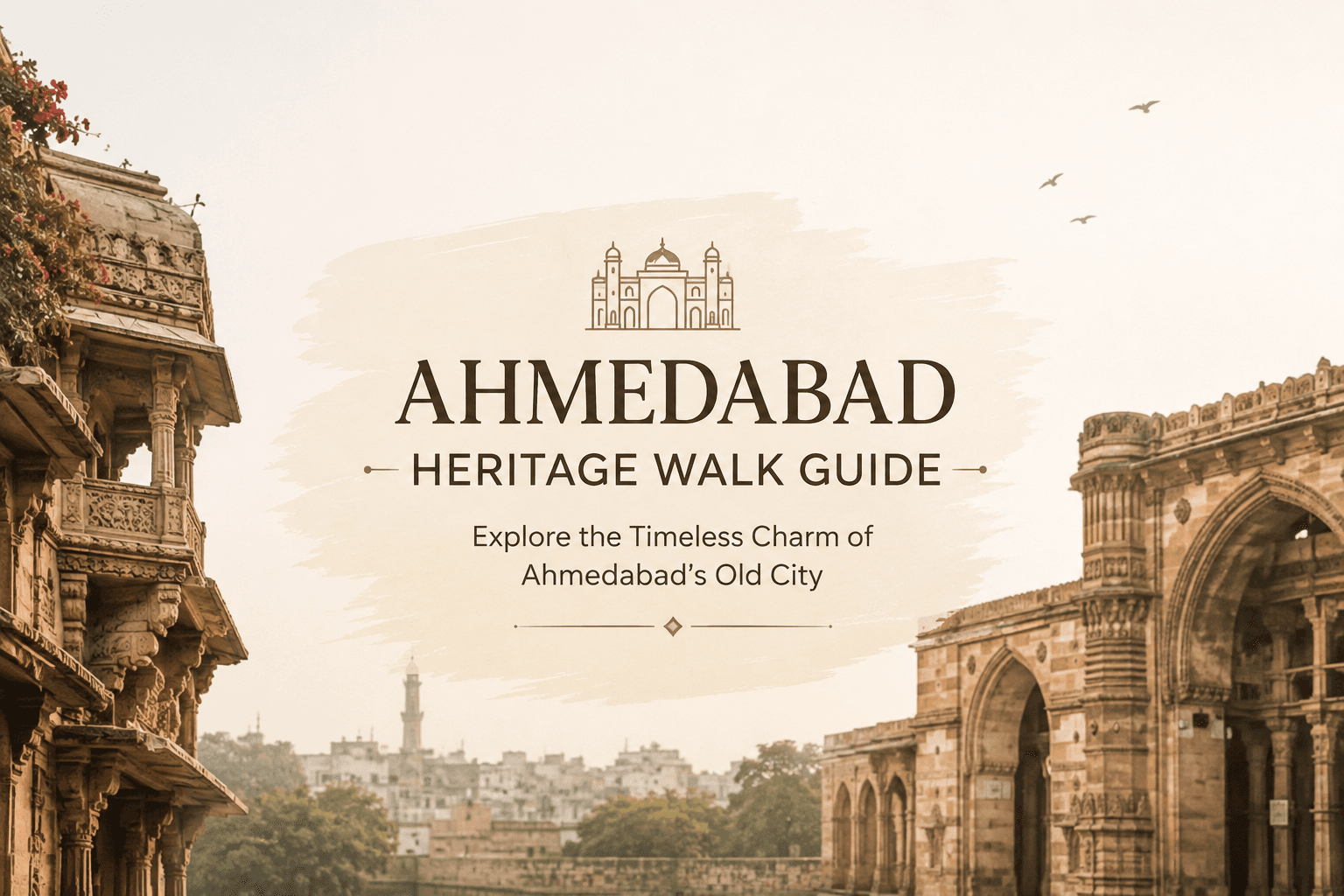
Ahmedabad is a city best understood on foot. Behind the traffic, textile markets and busy commercial streets of the modern city lies a historic urban landscape of pols, carved wooden houses, old mosques, temples, gateways, markets and centuries-old neighbourhoods. A thoughtfully planned Ahmedabad heritage walk lets you experience this living history at street level rather than simply viewing monuments from outside.
The historic walled city was founded by Sultan Ahmad Shah in 1411 and was inscribed as a UNESCO World Heritage City in 2017. Its heritage is not limited to individual monuments; the traditional neighbourhoods, narrow lanes, community spaces and timber architecture are equally important to its character.
For travellers interested in culture, architecture and local life, the old city offers a rewarding half-day experience. This guide covers what to see, how to plan your walk, which old Ahmedabad attractions deserve priority, what to eat along the way, and where to stay for convenient access.
Why Ahmedabad's Old City Is Worth Exploring on Foot
Ahmedabad's historic core is different from a conventional monument circuit. The experience comes from seeing how architecture, commerce, religion and community life fit together.
UNESCO describes the historic city as a dense urban fabric of traditional houses, pols, religious institutions, public wells and bird-feeding structures. Many of these elements remain part of everyday neighbourhood life rather than existing solely as preserved museum pieces.
That is what makes walking particularly valuable.
A narrow entrance may lead into a pol where elaborately carved façades sit alongside ordinary homes. A market street can suddenly open towards a historic mosque. A centuries-old gateway may stand beside a busy commercial road. The contrast between heritage and contemporary Ahmedabad is part of the experience.
If you enjoy photography, architecture, food or cultural history, allow yourself time to slow down rather than rushing from one landmark to another.
Ahmedabad Heritage Walk: The Classic Old-City Route
The city's official morning heritage walk begins at Swaminarayan Temple in Kalupur and moves through several important heritage areas before concluding around Jama Masjid. The current AMC itinerary takes roughly 2 hours to 2 hours 30 minutes.
1. Swaminarayan Temple, Kalupur
Starting in Kalupur immediately establishes the architectural character of the old city.
The temple complex is known for its colourful woodwork, ornate carvings and distinctive gateway. It was established in the early 19th century and remains an important religious site.
For visitors, the temple is also significant because the morning heritage route begins here. Arriving early gives you a chance to observe the neighbourhood before the streets become busier.
Dress respectfully because the route includes active religious sites.
2. Kavi Dalpatram Chowk and the Pols
From Kalupur, the route moves deeper into the traditional residential fabric of Ahmedabad.
The pols are among the most fascinating parts of the old city. These historic residential clusters were organised around community, security and shared resources. Look closely at the wooden façades, projecting balconies, carved brackets, entrances and small internal courtyards.
Do not treat the pols simply as photo stops. People still live and work in many of these neighbourhoods.
Keep noise low, avoid blocking entrances and ask permission before photographing residents or private homes.
3. Calico Dome and Layers of Urban History
The route also introduces travellers to architectural elements representing Ahmedabad's changing economic and industrial identity.
The city became closely associated with textiles, earning a reputation as an important industrial centre. This industrial history exists alongside much older Sultanate-era and traditional residential architecture.
One of the pleasures of exploring Ahmedabad is seeing these different periods within a relatively compact area.
4. Shantinath Ni Pol and Hidden Architectural Details
Some of the most memorable moments are not necessarily the largest monuments.
Traditional lanes can reveal details that are easy to miss from a vehicle: old wooden doors, carved windows, chabutros or bird-feeding structures, small shrines, community spaces and unusual passages between residential clusters.
This is where a guided walk can be more useful than a self-guided sightseeing circuit because the historical meaning of these details is not always obvious at first glance.
5. Manek Chowk
Eventually, the heritage experience intersects with one of Ahmedabad's busiest commercial and food districts.
Manek Chowk is important both historically and culturally. During the day, it functions as a traditional market area, while its food scene becomes particularly lively later in the day.
If your schedule permits, return to the area after sightseeing rather than trying to combine a full meal with the walking route. That gives you more time to explore the heritage streets without rushing.
Old Ahmedabad Attractions to Add to Your Itinerary
The classic walking route covers many highlights, but you can extend your exploration with several important old Ahmedabad attractions.
Jama Masjid
Built during the Sultanate period, Jama Masjid is one of the defining monuments of the historic city.
Its scale and architectural detailing make it an important stop for understanding Ahmedabad's medieval heritage. Visitors should remember that it remains a religious site and behave accordingly.
Sidi Saiyyed Mosque
The Sidi Saiyyed Mosque is particularly famous for its intricate stone latticework, especially the celebrated tree-of-life motif.
It is one of the city's most recognisable architectural details and a worthwhile stop for travellers interested in Indo-Islamic craftsmanship.
Bhadra Fort and Teen Darwaza
Bhadra Fort and Teen Darwaza help explain the defensive and ceremonial character of the old walled city.
Rather than viewing them as isolated monuments, consider them part of the historic city's larger network of gates, streets, markets and public spaces.
Badshah no Hajiro and Rani no Hajiro
These historic tomb complexes near Manek Chowk provide another perspective on Ahmedabad's Sultanate-era heritage.
Their proximity to busy markets creates an interesting contrast between monumental architecture and everyday commercial life.
Fernandes Bridge Book Market
For travellers who enjoy books and local markets, Fernandes Bridge offers a completely different experience.
The historic bridge area is associated with a book market beneath the road level, where visitors can browse educational books, used books, publications and stationery.
It is a good example of how Ahmedabad's heritage spaces have continued to evolve rather than becoming frozen in time.
How to Plan Your Walk
Choose the right time
For a comfortable walking experience, early morning is generally preferable, particularly during the warmer months.
AMC currently lists its morning heritage walk from 7:45 AM to around 10:30 AM. An evening heritage walk is also available, covering major sites in the walled city and ending around Manek Chowk.
Because schedules, booking arrangements and availability can change, check the official heritage-walk information shortly before your visit.
Wear comfortable footwear
The old city is best explored slowly, and parts of the route involve narrow streets and uneven walking surfaces.
Choose comfortable shoes rather than fashion footwear. Carry a small water bottle and avoid carrying unnecessary luggage.
Respect living neighbourhoods
This is one of the most important rules.
A heritage walk passes through communities where people live, worship, work and conduct business every day. Avoid entering private homes, photographing people without consent or treating residential lanes as a photo set.
Keep some time for food
Ahmedabad's heritage experience is incomplete without exploring its food culture.
Depending on your route and schedule, look for local Gujarati snacks, fafda-jalebi, khakhra, handvo, khandvi and other regional specialities. Manek Chowk is particularly well known for its food scene.
For a more relaxed experience, separate your food exploration from the main walking route.
Best Season for a Heritage Walk in Ahmedabad
For cultural tourism, the cooler months are generally more comfortable for walking through the old city.
October to February is particularly suitable because daytime conditions are usually more pleasant than during peak summer. Winter mornings can be ideal for combining the heritage walk with photography and a relaxed breakfast afterwards.
March onwards can become increasingly warm. If travelling during hotter months, prioritise an early start, carry water and avoid extending the walking route unnecessarily during midday.
The monsoon can add a different atmosphere to the city, but wet streets may make walking less comfortable. Check the weather forecast before committing to a longer self-guided route.
Getting Around Ahmedabad
Ahmedabad is well connected by air, rail and road.
Sardar Vallabhbhai Patel International Airport serves the city, while Ahmedabad Junction is an important railway hub. The central areas of the historic city are accessible from major parts of Ahmedabad by taxi, auto-rickshaw and local public transport.
For the heritage core itself, walking is the most rewarding option.
Avoid depending entirely on a car for the old-city circuit. Traffic, narrow streets and limited stopping space can make short distances surprisingly time-consuming.
A practical approach is to use transport to reach the starting point, walk the heritage core, and then use a taxi or auto-rickshaw for your next destination.
Where to Stay in Ahmedabad
Choosing the right neighbourhood can make a significant difference to a heritage-focused trip.
Old City: Best for travellers who want to stay close to the heritage environment and traditional markets. It offers the strongest sense of place but may feel busy and less convenient for travellers seeking a quieter hotel environment.
Ashram Road: A practical choice for business and leisure travellers who want easier citywide connectivity while remaining reasonably close to the historic centre.
Navrangpura: Suitable for travellers looking for restaurants, shopping and a more modern urban setting.
Paldi: A useful option for travellers who want access to central Ahmedabad while staying away from some of the busiest old-city streets.
For hotel selection, compare location, guest reviews, parking availability, breakfast options and access to your planned sightseeing route. Goroomgo can be used to compare accommodation options in Ahmedabad based on your travel dates and preferred location.
A Practical Half-Day Plan
If you have only one morning, avoid trying to cover every attraction.
7:30–8:00 AM: Reach the Kalupur area.
8:00–10:30 AM: Follow the heritage route through the pols and historic neighbourhoods towards Jama Masjid.
10:30–11:00 AM: Take a breakfast or refreshment break.
11:00 AM–12:00 PM: Explore nearby Bhadra Fort, Teen Darwaza or Sidi Saiyyed Mosque, depending on access and your interests.
After 12:00 PM: Continue towards another Ahmedabad attraction or return to your hotel to rest.
If you have a full day, consider adding Sabarmati Ashram, the Calico Museum area, Adalaj Stepwell or Kankaria Lake separately rather than forcing everything into the heritage walk.
Why the Old City Experience Stands Out
What makes Ahmedabad distinctive is that its heritage is not confined to a handful of monumental buildings.
The real story is found in the relationship between the buildings and the people who shaped the city over centuries. The pols reveal community organisation. The wooden houses demonstrate regional craftsmanship. Mosques and temples reflect the city's multicultural history. Markets show how commercial traditions continue to influence urban life.
That combination makes the old city more than a sightseeing destination.
It becomes an urban history lesson experienced one street at a time.
An Ahmedabad heritage walk is one of the most rewarding ways to understand the city's cultural identity. Instead of moving quickly between isolated monuments, you experience the connected landscape of pols, markets, temples, mosques, wooden houses, historic gateways and neighbourhood streets.
Start early, wear comfortable footwear, respect residential communities and leave enough time to appreciate the details between the major landmarks. Add Manek Chowk for food, Sidi Saiyyed Mosque for architecture and Bhadra Fort and Teen Darwaza for a broader understanding of the walled city.
Whether Ahmedabad is a weekend stop or part of a longer Gujarat itinerary, exploring its historic core on foot gives the trip a deeper sense of place. Plan your route around the season, choose a convenient hotel through Goroomgo, and allow yourself enough time to experience the city rather than simply pass through it.
Written by Goroomgo Editorial Team
Travel Writers & Hospitality Experts
We are dedicated to bringing you the best budget travel tips, hotel reviews, destination guides, and stories to inspire your next adventure across India.