

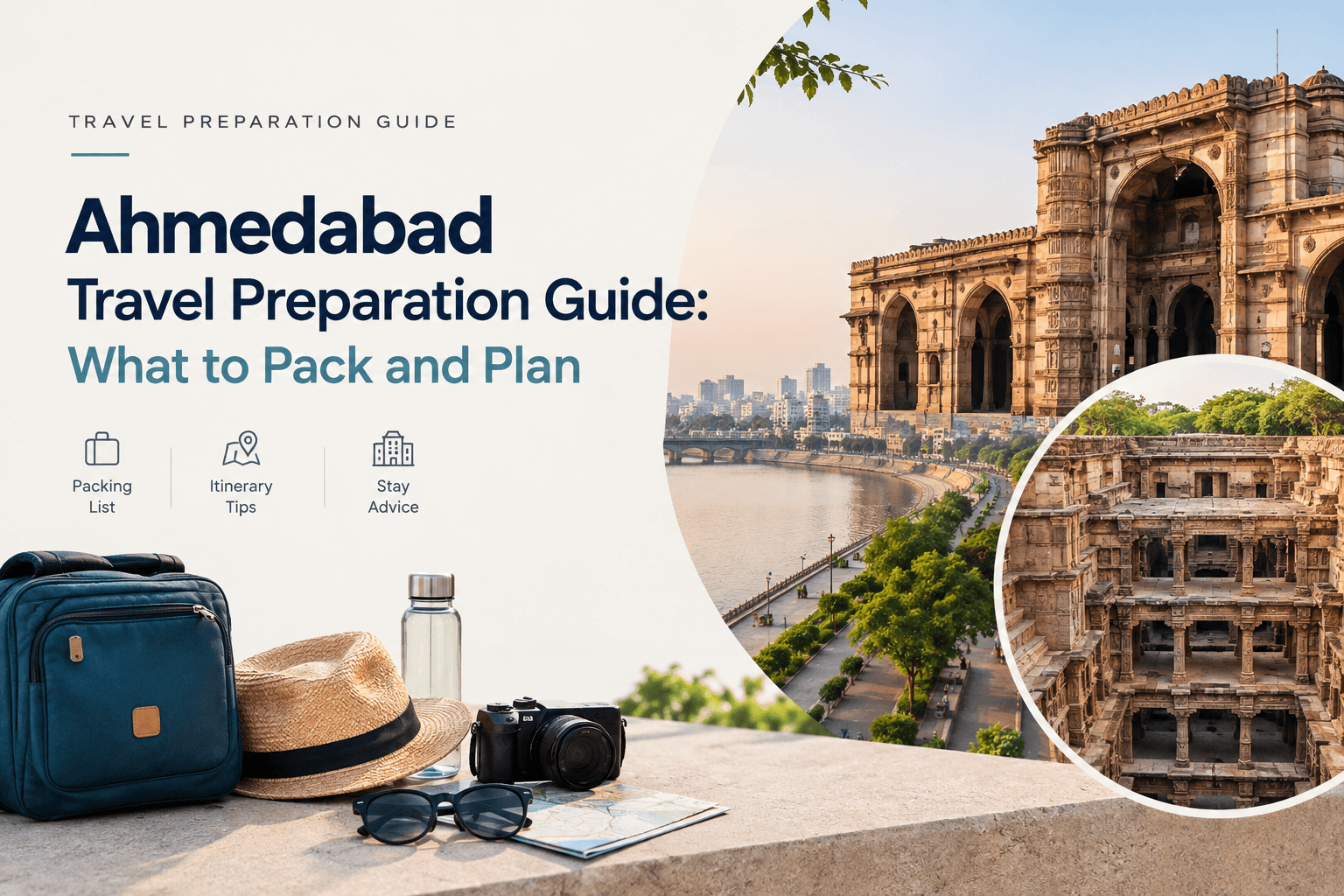
Ahmedabad is not a city you experience entirely from a car window. Its character appears while walking through the old-city pols, looking closely at carved wooden houses, moving through Manek Chowk, visiting Sabarmati Ashram and stopping for Gujarati food along the way. That makes preparation particularly important. Your Ahmedabad packing list should account for walking, seasonal weather, heritage sites, local markets and the pace of an Indian city.
Ahmedabad, also known locally as Amdavad, is India’s first UNESCO World Heritage City, with its historic walled city, pol neighbourhoods and Indo-Islamic, Hindu and Jain architecture forming an important part of its identity.
This guide focuses specifically on what to pack for Ahmedabad trip plans, how to organise your sightseeing around the city, what to carry for Old City exploration, how to prepare for places such as Adalaj Ni Vav, and which areas make practical bases for different types of travellers.
Ahmedabad Packing List: Pack for the Way You Will Explore the City
The right Ahmedabad packing list depends less on the number of attractions you want to visit and more on how you plan to move between them.
If your itinerary includes the Old City, expect walking through narrow streets and heritage precincts. Gujarat Tourism describes Ahmedabad’s pols as traditional residential clusters with narrow lanes, community spaces, gates and intricately carved wooden houses.
That means comfortable walking shoes should be one of your first choices. Avoid taking a brand-new pair of shoes on the trip. A broken-in pair with good grip is more useful for a morning heritage walk than fashionable footwear that becomes uncomfortable after two hours.
For clothing, choose lightweight, breathable outfits for daytime sightseeing. Cotton shirts, T-shirts, loose trousers, comfortable dresses and other airy clothing work well for most city itineraries. Carry a light scarf or stole as an additional layer when visiting religious or culturally significant places.
Your day bag should be small enough for walking through crowded areas but large enough for:
- Reusable water bottle
- Sunglasses
- Sunscreen
- Phone and power bank
- Wallet and identification
- Hand sanitiser or tissues
- Small umbrella during monsoon
- Any essential medication
The objective is simple: carry what you need for a full Ahmedabad sightseeing day without carrying your entire luggage.
What to Pack for Ahmedabad Trip Days Around the Old City
The what to pack for Ahmedabad trip question becomes more specific if the Old City is on your itinerary.
A morning heritage walk can take you through the Kalupur area, pols, historic houses, religious landmarks and eventually towards Jama Masjid. Gujarat Tourism’s heritage information describes the official walk as beginning at Kalupur Swaminarayan Temple and ending at Jama Masjid.
For this experience, prepare for walking rather than sightseeing from one monument to another by vehicle.
Carry:
Comfortable footwear: The Old City is best explored on foot, particularly when you want to notice architectural details rather than simply photograph major landmarks.
Water: Start the walk hydrated, especially during warmer months.
Minimal luggage: Narrow lanes and busy areas are easier to navigate with a compact backpack or crossbody bag.
Phone/camera: Ahmedabad’s carved façades, jharokhas, wooden details and old neighbourhoods provide plenty of photographic opportunities.
Respectful clothing: Your route can include temples, mosques and other religious spaces, so avoid planning your sightseeing wardrobe around beachwear or overly casual clothing.
A particularly useful preparation tip is to schedule the Old City early in the day. Gujarat Tourism lists its heritage walk as a morning experience, which also makes practical sense for walking through the historic core before the day becomes hotter and busier.
Ahmedabad Travel Essentials for Sabarmati Ashram and Riverfront
Two very different Ahmedabad experiences can be planned around the Sabarmati: the reflective atmosphere of Sabarmati Ashram and the more open urban setting of the Sabarmati Riverfront.
Sabarmati Ashram was Gandhi’s residence and is closely associated with India’s freedom movement. The site includes Hriday Kunj and the museum, and Gujarat Tourism currently lists the ashram as open daily from 10:00 AM to 6:00 PM.
For an Ashram visit, there is no need for specialised equipment. Instead, prepare for a quieter cultural experience. Carry water, a phone or camera if you wish to document the visit, and clothing suitable for a place of historical and cultural significance.

For the Riverfront, your Ahmedabad travel essentials should be more practical: comfortable footwear, sun protection and water. If you plan to walk along the riverfront around sunset, keep your schedule flexible rather than trying to combine it with too many Old City stops.
A useful planning combination is to visit Sabarmati Ashram separately from the intensive Old City walking route. This gives each experience enough time instead of turning both into rushed photo stops.
Plan Your Day Around Manek Chowk, Not Just Around Attractions
Manek Chowk is one of the best examples of why Ahmedabad requires destination-specific planning.
It is not simply a market that remains the same throughout the day. Gujarat Tourism describes it as a vegetable market in the morning, a bullion market around midday and a street-food destination at night.
That makes timing part of your packing and preparation strategy.
If Manek Chowk is on your itinerary for food, do not plan your visit like a conventional daytime sightseeing attraction. Leave room for an evening food experience and carry a light layer if you are travelling during cooler months.
If you are shopping in the Old City or around Law Garden, take a foldable shopping bag. It weighs almost nothing in your luggage but becomes useful once you start collecting textiles, handicrafts, souvenirs or local products.
And keep your wallet, phone and other valuables secure in busy market areas. A compact crossbody bag with a secure closure is more practical than an open tote.
Ahmedabad Travel Tips for First-Time Visitors: Build the Itinerary by Area
One of the most useful Ahmedabad travel tips for first-time visitors is to stop planning the city as a simple list of attractions.
Instead, group nearby experiences.
Old City Day
Combine the Kalupur area, heritage walk, pols, Jama Masjid, Sidi Saiyyed Mosque, Bhadra area and Manek Chowk according to opening hours and your interests. Gujarat Tourism identifies many of these locations as key components of Ahmedabad’s heritage landscape.
The important preparation point is footwear and timing. This is your walking-heavy day.
Sabarmati Day
Combine Sabarmati Ashram with nearby attractions and the Riverfront rather than repeatedly crossing the city. Keep the afternoon less crowded with activities so you have time to absorb the Ashram’s museum and surroundings.
Adalaj Excursion
If you want to visit Adalaj Ni Vav, treat it as an excursion outside the core Old City itinerary. Gujarat Tourism describes the five-storey stepwell as an important example of the region’s historic architecture and lists it among Ahmedabad’s nearby experiences.
Wear shoes suitable for steps and uneven surfaces, carry water and avoid assuming that every Ahmedabad attraction can be covered comfortably in one continuous walking route.
Kankaria and Family Time
For families, Kankaria Lake can provide a change from heritage-focused sightseeing. Keep a lighter schedule around family attractions rather than combining them with an exhausting Old City walking day.