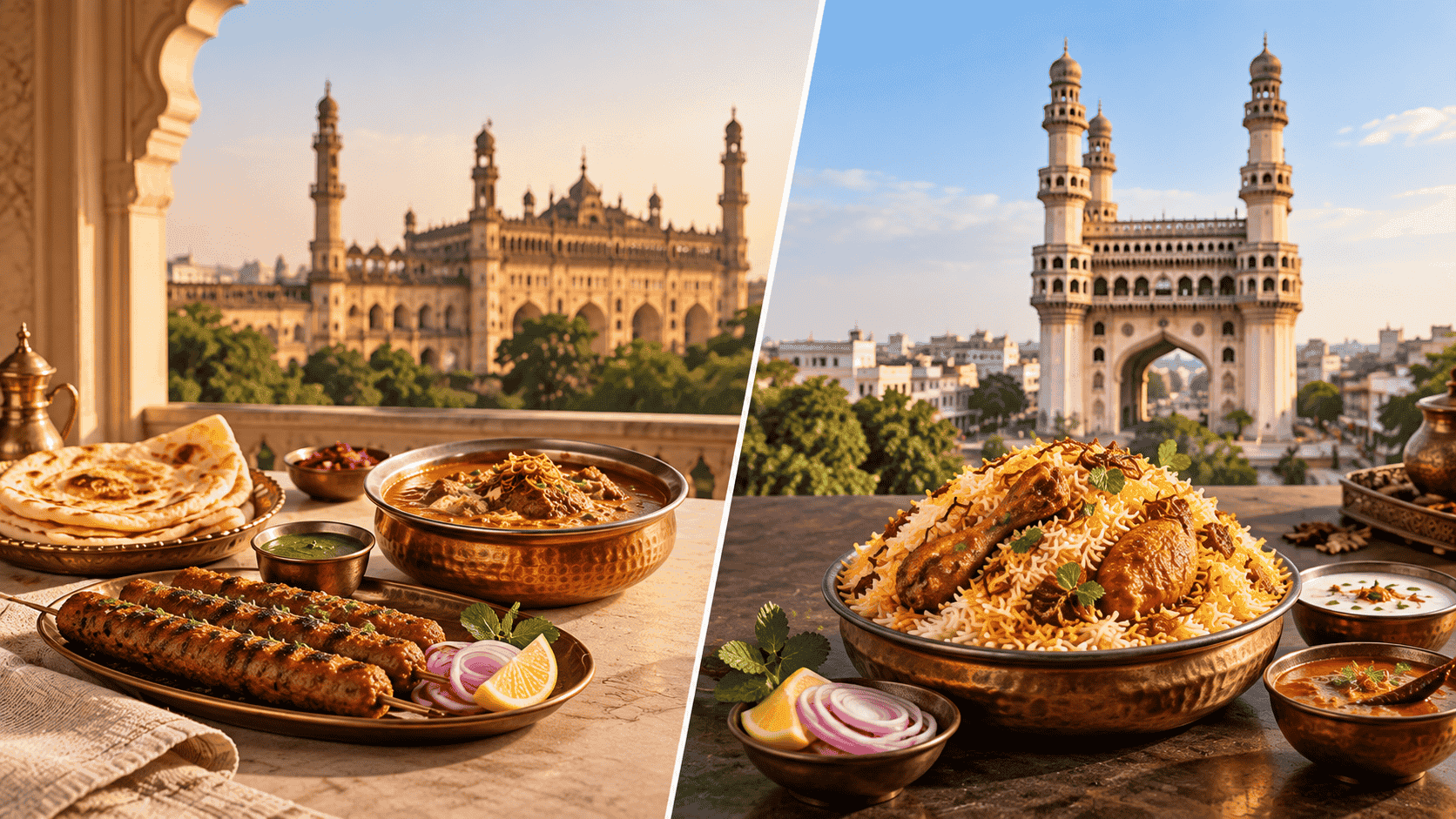
Food tourism in India often comes down to a choice between two royal kitchens that shaped how the country thinks about spice, aroma and slow cooking. Lucknow and Hyderabad both claim deep Mughal-Persian roots, yet the plates that leave their kitchens feel like different conversations.
One speaks in soft, layered fragrance. The other announces itself with heat and intensity. This Lucknow vs Hyderabad food comparison looks at the real differences in technique, atmosphere and everyday eating so travellers can decide which city matches the kind of meal they want to remember.
The Philosophical Divide
Lucknow’s Awadhi cuisine grew in the courts of the Nawabs, where refinement and restraint were marks of sophistication. Dishes are built around subtlety: whole spices, floral waters, and the patient dum method that lets aroma rise without shouting. Meat is often cooked separately and then finished with rice so every grain stays light and distinct.
Hyderabad’s kitchens, shaped by the Nizams and the Deccan plateau, favour bolder expression. The famous kacchi style layers raw marinated meat with rice so the two cook together, exchanging flavour in a sealed pot. The result is richer, spicier and more assertive—flavours that arrive all at once rather than unfolding slowly.
Neither approach is superior. They simply reward different appetites.
Biryani: The Central Debate
Any Lucknow vs Hyderabad food discussion eventually reaches biryani. The two versions look similar on the plate yet taste like different dishes.
Lucknowi (Awadhi) biryani follows the pakki method. Meat is cooked first in a fragrant yakhni, then layered with partially cooked basmati and finished on dum. The spices stay restrained—cardamom, cinnamon, cloves, saffron and a touch of kewra or rose. The rice remains fluffy and separate; the meat is exceptionally tender. The overall impression is aromatic and elegant.

Hyderabadi biryani is typically kacchi. Raw marinated meat and rice cook together under dum. Fried onions, mint, green chillies, yogurt and a stronger spice blend create a bold, layered heat. The grains often show a mix of colour and the dish feels richer and more intense. Mirchi ka salan and a cooling raita usually sit alongside it.
Travellers who prefer subtle fragrance and refined balance tend to favour Lucknow. Those who want heat, depth and a more dramatic first bite lean toward Hyderabad.
Kebabs, Street Food and the Wider Table
Lucknow’s reputation rests heavily on its kebabs. Galouti—soft enough to melt without chewing—is the most famous, traditionally made for a Nawab who could no longer manage tougher textures. Kakori, seekh and other varieties appear across Chowk and Aminabad, often eaten with roomali roti or sheermal. Morning nihari with kulcha and evening chaat trails add further layers to a full day of eating.

Hyderabad answers with haleem (especially during Ramadan), rich nihari of its own, and the everyday comfort of Irani cafés—Osmania biscuits, strong chai and simple bakery items that form a parallel street culture. Around Charminar the energy is denser and more continuous; the flavours tend to be sharper and more immediate.
Lucknow’s food experience often feels measured and sequential. Hyderabad’s can feel more continuous and high-energy, especially in the older quarters.
Atmosphere and Food Tourism Experience
In Lucknow the classic trail moves through Chowk, Aminabad and Hazratganj. The pace is unhurried. Many of the best-known counters have been serving the same specialities for generations. The recent recognition of Lucknow as a UNESCO Creative City of Gastronomy has drawn more attention to both the heritage establishments and the wider vegetarian and Kayastha traditions that sit alongside the famous meat dishes.
Hyderabad’s food map centres on the Old City, the lanes around Charminar, and a growing number of refined restaurants that interpret the same heritage for modern diners. The intensity of the street is higher; the flavours arrive faster. For many visitors the combination of biryani, haleem and Irani café culture creates a single, continuous sensory day.
Both cities reward slow walking and repeated visits to the same neighbourhoods rather than one-off restaurant stops.
Which City Suits Which Traveller?
Choose Lucknow if you value aroma over heat, prefer soft textures and refined presentation, and enjoy a food trail that feels like a sequence of carefully paced experiences. The city suits travellers who want to understand technique as much as taste.
Choose Hyderabad if you prefer bold spice, richer gravies and a more immediate, high-energy eating culture. The city suits those who want intensity and variety packed into a shorter, denser exploration.
Many travellers who care about food tourism in India eventually visit both. The contrast itself becomes part of the education: the same royal inheritance expressed in two different voices.
Practical Notes for a Food-Focused Trip
In both cities the most memorable meals often happen at long-established neighbourhood counters rather than only at fine-dining addresses. Arriving slightly off-peak, asking for the house speciality, and allowing time to sit rather than rush improves the experience.
Staying in a central or old-city location shortens the distance between one meal and the next. A well-chosen base lets the food trail unfold on foot or with short rides instead of long transfers. Platforms such as Goroomgo help compare stays that sit close to the main eating quarters in either city so the logistics support the eating rather than interrupting it.
Conclusion
Lucknow vs Hyderabad food is less a contest with a single winner than a choice between two complete philosophies. Lucknow offers restraint, fragrance and melt-in-the-mouth technique. Hyderabad offers boldness, heat and continuous intensity.
The better food experience is the one that matches the kind of pleasure a traveller is seeking on that particular trip. For many people the real answer is sequential: one city first, the other later, so the contrast itself becomes part of the memory of food tourism in India.

Written by Kunal Paul
Travel Expert
Kunal Paul is a Travel Expert who turns journeys into memorable experiences. With a passion for discovering destinations, local culture, hidden gems, and practical travel insights, he helps travelers explore smarter and better.