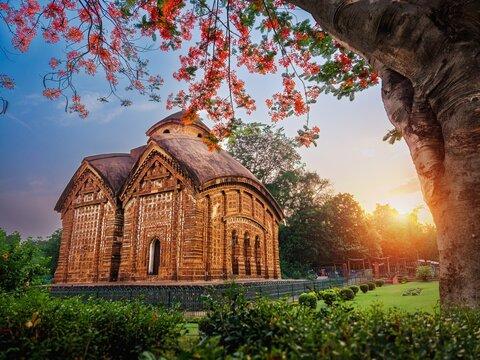
The Historical Significance of Bishnupur
Bishnupur was once the capital of the Malla Dynasty, which ruled the region for nearly a thousand years. The Malla kings were great patrons of art, culture, architecture, and religion. During the 17th and 18th centuries, they constructed numerous terracotta temples that continue to attract tourists from across India and abroad.
The town's unique temple architecture, crafted primarily from laterite stones and baked clay, earned Bishnupur a prominent place on India's heritage tourism map.
Ancient Temples to Visit in Bishnupur
1. Rasmancha
The Rasmancha is the most iconic monument in Bishnupur. Built in 1600 AD by King Bir Hambir, it is considered the oldest brick temple in the town.
Unlike conventional temples, Rasmancha was designed as a ceremonial platform where idols from different temples were displayed during the annual Ras festival. The structure features a unique pyramidal roof surrounded by numerous arches, making it architecturally distinct.
Short History: King Bir Hambir commissioned Rasmancha to celebrate Vaishnav traditions and facilitate public worship during religious festivals.

2. Jor Bangla Temple
Built in 1655 AD by King Raghunath Singha, the Jor Bangla Temple is one of the finest examples of Bengal's terracotta architecture.
The temple resembles two traditional Bengali huts joined together, hence the name "Jor Bangla." Its walls showcase intricate terracotta carvings depicting scenes from the Ramayana, Mahabharata, and Krishna Leela.
Short History: The temple was dedicated to Lord Krishna and reflects the artistic excellence achieved during the Malla period.

3. Shyam Rai Temple
Constructed in 1643 AD by King Raghunath Singha, the Shyam Rai Temple is famous for its exquisite five-towered (Pancharatna) architecture.
The temple is adorned with elaborate terracotta panels illustrating mythological narratives, social life, and royal ceremonies.
Short History: Dedicated to Lord Krishna as Shyam Rai, this temple symbolizes the growing influence of Vaishnavism during the Malla reign.

4. Madan Mohan Temple
The Madan Mohan Temple is among the most revered temples in Bishnupur. Built in 1694 AD by King Durjana Singha, it remains an active place of worship.
The temple follows the Eka-Ratna architectural style and is renowned for its detailed terracotta artwork depicting episodes from Hindu epics.
Short History: According to local legends, the deity Madan Mohan protected Bishnupur from Maratha invasions.
5. Lalji Temple
Built in 1658 AD by King Bir Singha II, Lalji Temple is another remarkable Eka-Ratna temple dedicated to Lord Krishna.
Its elevated platform and decorative terracotta facades make it a significant attraction for history lovers.
Short History: The temple was constructed during the peak of Malla architectural development and served as an important center of Vaishnav worship.
6. Radha Shyam Temple
Constructed in 1758 AD by Chaitanya Singha, the Radha Shyam Temple is one of the last major temples built by the Malla rulers.
This laterite temple exhibits beautiful floral motifs and ornamental terracotta decorations.
Short History: The temple reflects the gradual transition in temple architecture during the declining years of the Malla kingdom.

Written by Kunal Paul
Travel Expert
Kunal Paul is a Travel Expert who turns journeys into memorable experiences. With a passion for discovering destinations, local culture, hidden gems, and practical travel insights, he helps travelers explore smarter and better.
